
Between 2021 and 2025, comprehensive fieldwork was carried out during the fall semesters through interdisciplinary and international initiatives, aiming to investigate the architectural origins of Turkish architecture and its interregional interactions. These studies focused on museum collections and architectural sites in Uzbekistan, Iran, Türkiye, and the Caucasus, which exhibit distinctive elements of Turkish cultural and stylistic presence. Workshops were conducted in historically significant urban centers, including Samarkand, Bukhara, Tashkent, Fergana, Tabriz, Isfahan, Tehran, and Konya.
The workshops, particularly those held in 2022, 2023, and 2024, typically concluded with an international symposium in Istanbul, attended by distinguished scholars from Iran, Uzbekistan, and Azerbaijan. The fourth symposium was held in Konya on April 9, 2025. The proceedings of these academic gatherings were subsequently published in successive volumes. During these symposia, it was particularly emphasized that certain architectural motifs identified in the 9th-century Samanid Mausoleum in Bukhara and in sites across Iran were also present in religious architecture in Armenia and Georgia—most notably in churches and monasteries—and that many of these motifs later resonated in the early Ottoman architectural language of the Balkans and Thrace.
Several remarkable findings were brought to scholarly attention to encourage further inquiry. These included the 3rd-century Buddhist monastery Taş Rabat along the Silk Road in Kyrgyzstan, a vaulted Buddhist relief uncovered at the Fayaztepa archaeological site in southern Uzbekistan, and a distinct pointed Turkish arch excavated at the Afrasiab site in Samarkand. (See Proceedings of the 1st, 2nd, and 3rd Central Asian Studies Symposiums)
One of the key focal points of these symposia was the Great Seljuk Empire, founded by the Kınık branch of the Oghuz Turks in the early 11th century. Discussions explored the connections between Anatolian Seljuk architectural traditions and the heritage of the pre-Islamic Persian Empire, with a particular emphasis on the transformations that led up to the Mongol invasions of the 13th century. Furthermore, the architectural influence of Buddhist, Zoroastrian, and Islamic communities was analyzed in detail through a comparative civilizational lens.
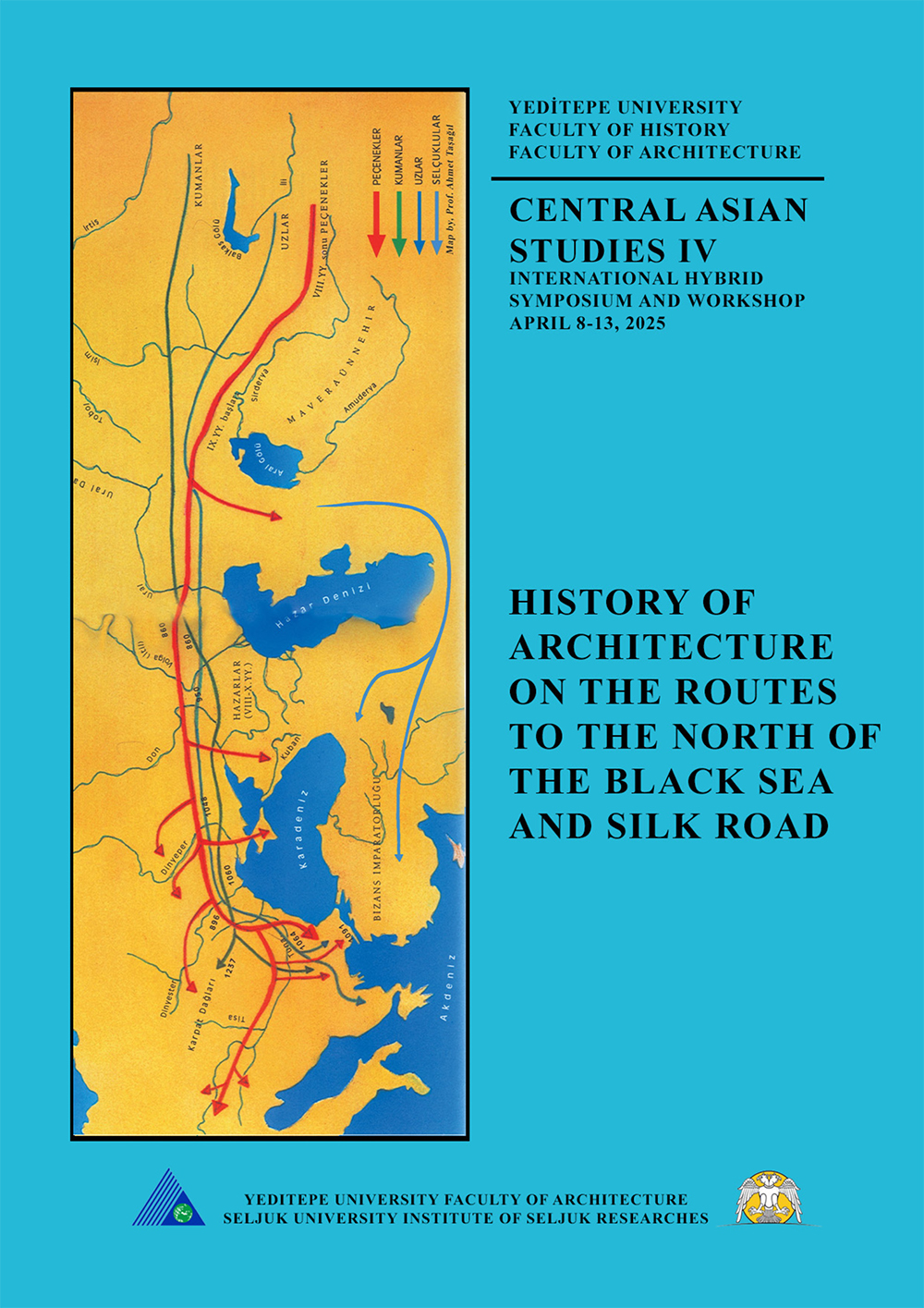
Contrary to the prevailing historical narrative that situates the Turkish presence in Anatolia post-1071 following the Battle of Manzikert, the research indicates earlier phases of Turkish settlement in the Black Sea steppes, the Caucasus, Crimea, and certain regions of the Balkans. These settlements—established by early Turkic entities such as the Huns, Khazars, and Bulgars—represent proto-urban centers that played a significant role in the dissemination of architectural knowledge. Accordingly, this current symposium aims to examine the early development of Turkish architecture along the Iranian corridor of the Silk Road and its northern extension through the Caucasus into Thrace.